
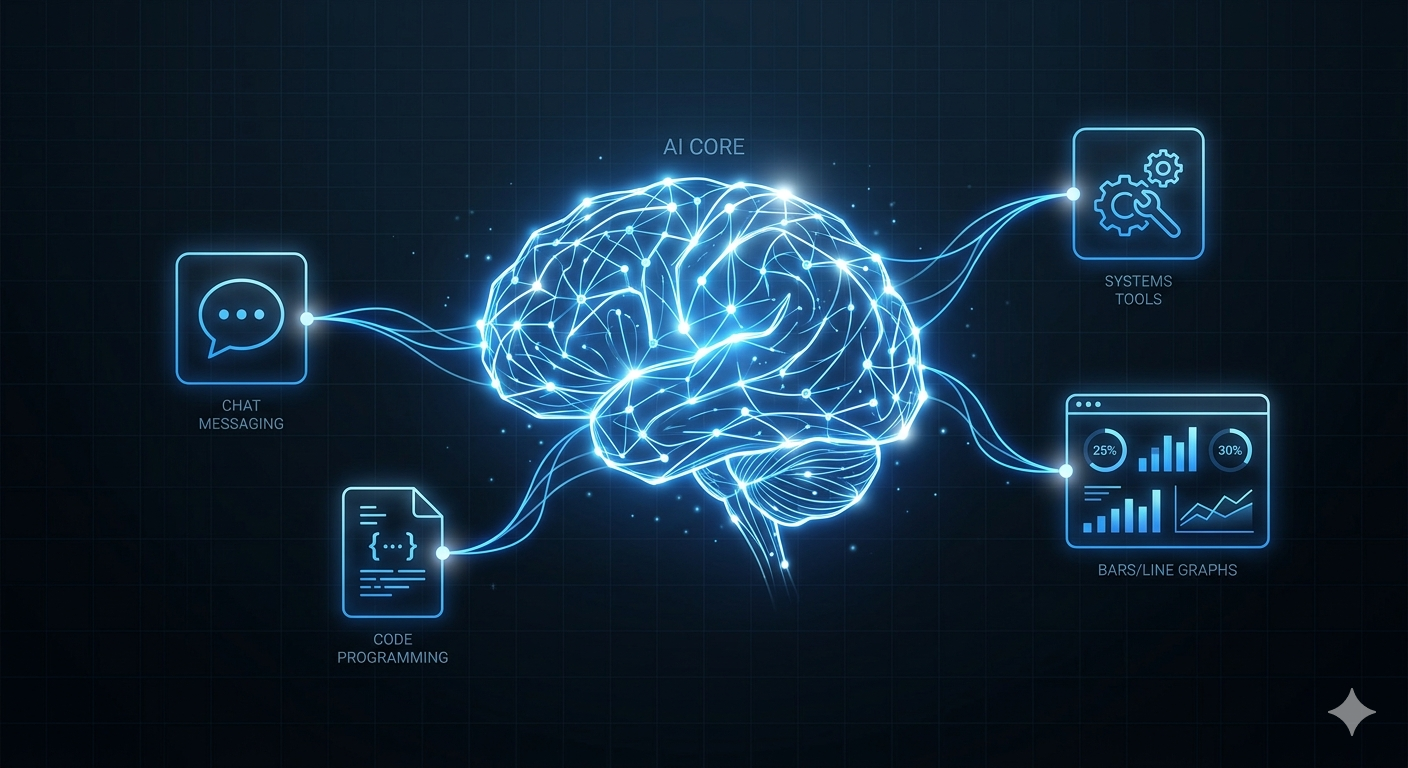
A few days ago, someone said something that stuck.
“I keep hearing words like GPT, agents, Claude, RAG, context… but I still don't understand one thing, if I want to build something with AI, where do I even begin?”
That confusion is everywhere right now. AI feels powerful, almost unavoidable, but when it comes to actually using it, things start to feel unclear very quickly. The problem is not that AI is complicated, it's that it's usually explained in a complicated way.
It starts with the “brain”
Every AI product you see, chatbots, assistants, tools runs on something like a brain. This is what people call a “MODEL”.
In practice you will bump into product names (GPT, Claude, Gemini, open models). They differ in quality, cost, and safety settings, but the role is the same: they generate the next tokens from what you show them.
But here's the surprising part. This brain doesn't actually think. It predicts. It looks at your input and guesses what should come next, just like your phone suggests the next word, but at a much larger scale.
That simple idea is what powers everything.
Why AI feels smart… and then suddenly isn't
If you've used AI, you've seen this. Sometimes it gives amazing answers, and other times it completely misses the point.
The reason is simple: it can only respond based on what it can see.
Whatever information you give it in that moment becomes its entire world. This is what people call “CONTEXT”. In simple terms, it's just the AI's working memory.
Understanding the context window (the real limitation)
Now here's the part most people don't fully understand.
AI cannot see unlimited information. There's a limit to how much it can handle at once. That limit is called the context window.
Imagine a person working on a desk.
- If the desk is small, only a few papers fit.
- If the desk is large, you can spread out entire files and understand everything together.
The context window is that desk.
If it's small, the AI only sees a little bit. If it's large, it can see a lot, sometimes entire documents.
This is why two AI tools can feel completely different, even if they use similar models.
What this looks like in a real task
- You ask AI to analyze a long business report.
- If it can only see a few pages, it gives shallow answers.
- If it can see the entire report, it gives deep insights.
Same AI. Different visibility. Completely different result.
Another way to think about it, it's like watching a movie.
If you only watch random clips, nothing makes sense. But if you watch the whole thing, you understand the story.
The context window decides how much of the “story” the AI can understand at once.
The real problem most people miss
Even with a large context window, there's still a big issue.
AI does not know your business.
It doesn't know your products, your customers, your internal data, or your documents. So if you build something without solving this, the AI starts guessing, and that's where things break.
Where RAG changes everything
Instead of expecting AI to magically know everything, you give it the right information before it answers.
That's all RAG really is.
Think of it like an employee. If you ask them to answer questions without any knowledge, they'll struggle. But if you give them access to the right documents, they suddenly become effective.
AI works exactly the same way.
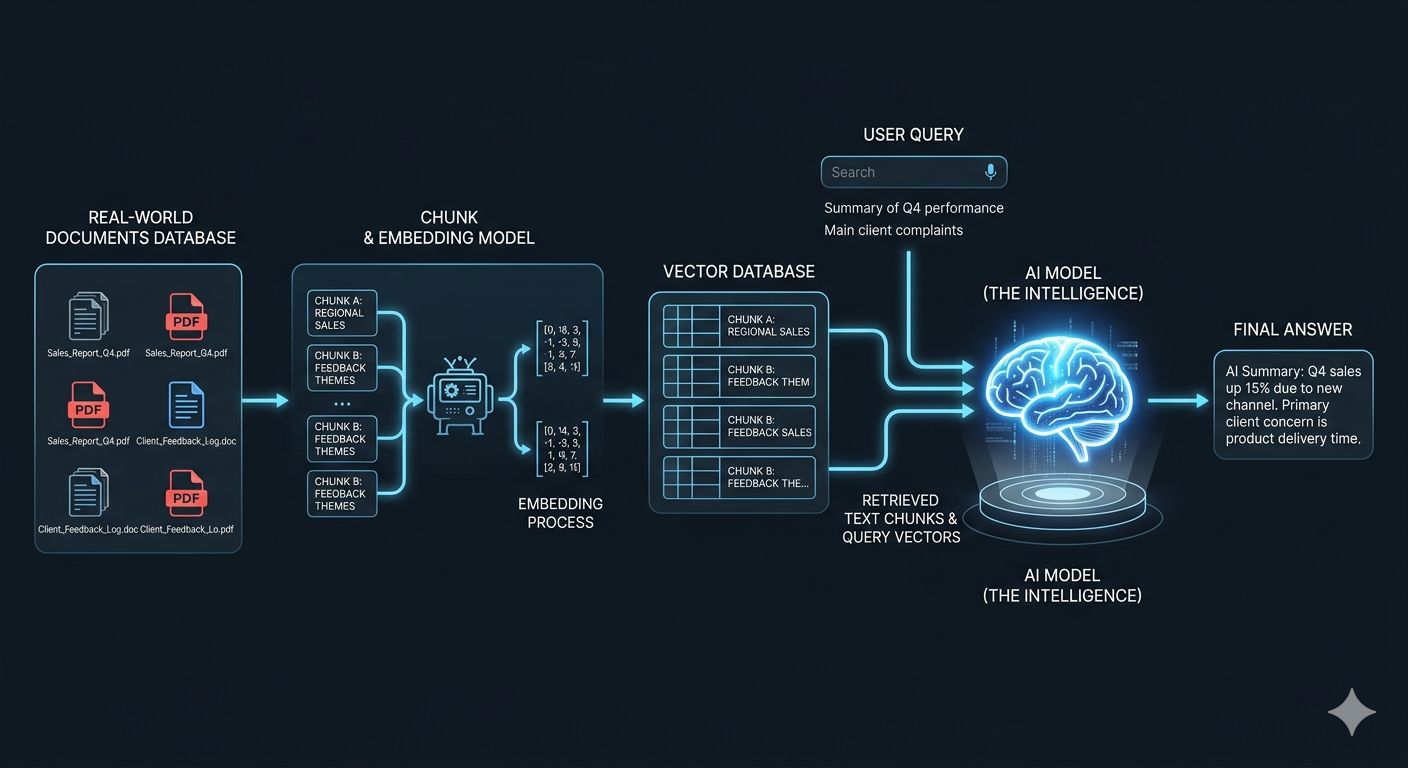
Now let's make this real.
A customer asks, “Where is my order?”
Without any connection to your system, the AI gives a generic answer like “orders usually take a few days.”
But with the right setup, your system first pulls the actual order data and then gives it to the AI. Now the answer becomes: “Your order was shipped yesterday and will arrive tomorrow.”
That's the difference between guessing and knowing.
The same pattern applies everywhere.
- A doctor asking about a patient's history.
- A lawyer reviewing a contract.
- An employee checking company policy.
In each case, the value of AI comes from its access to the right information at the right time.
Putting it all together
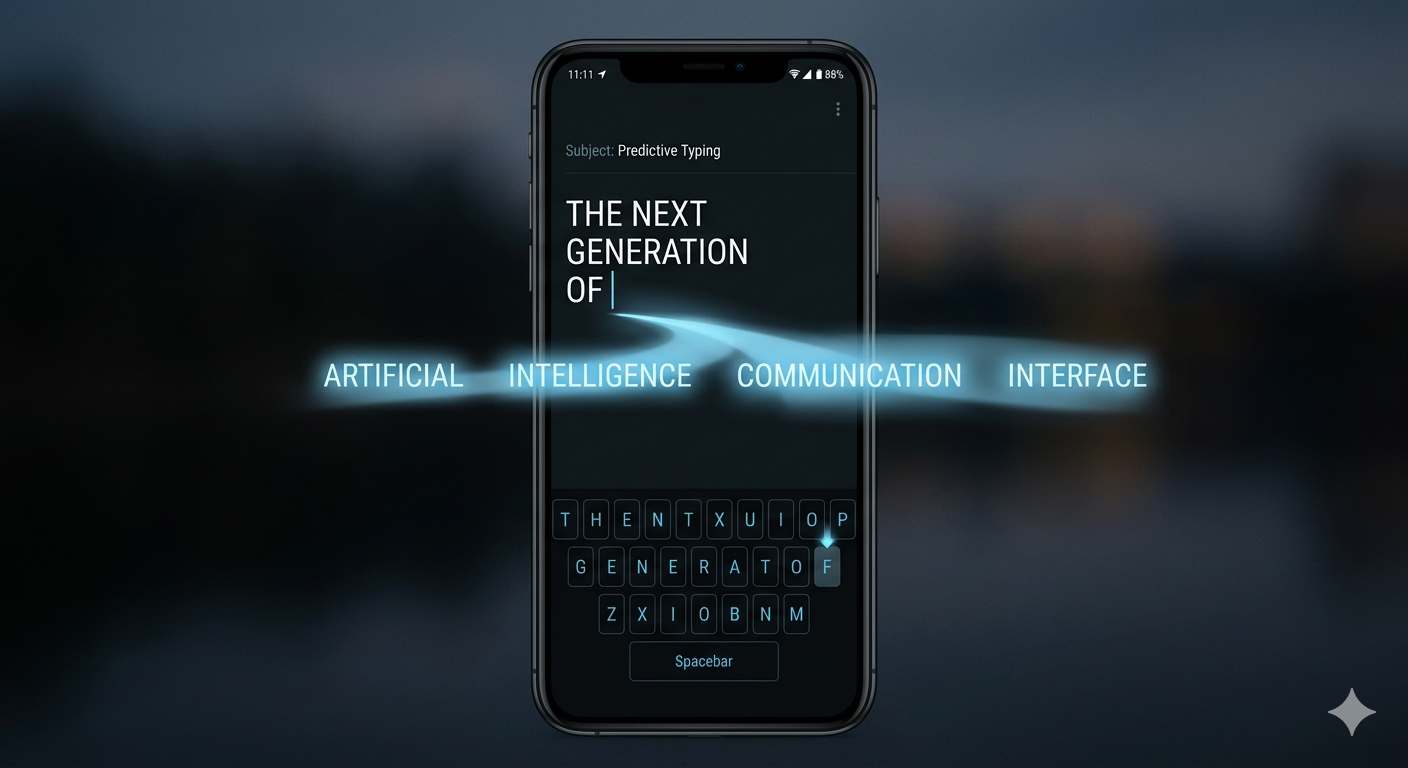
Once you see this clearly, AI stops feeling complicated.
- There is always a brain generating responses.
- There is a limited memory that controls how much it can see.
- There is a system that feeds it the right data when needed.
If any one of these is missing, the result feels weak.
But when they work together, AI becomes something powerful enough to build real products on.
There is no “best AI.” There is only the right setup for your idea.
At CloudGeniee, this is exactly what we focus on, turning that confusion into clarity, and helping ideas become real systems.
Because once you understand the structure, AI stops feeling like hype… and starts feeling like something you can actually use.
Want help with RAG or AI in production?
If you want us to manage RAG pipelines, wire models to your data safely, or talk through what to build first, book a free meeting. We'll look at your goals and suggest a practical next step.